
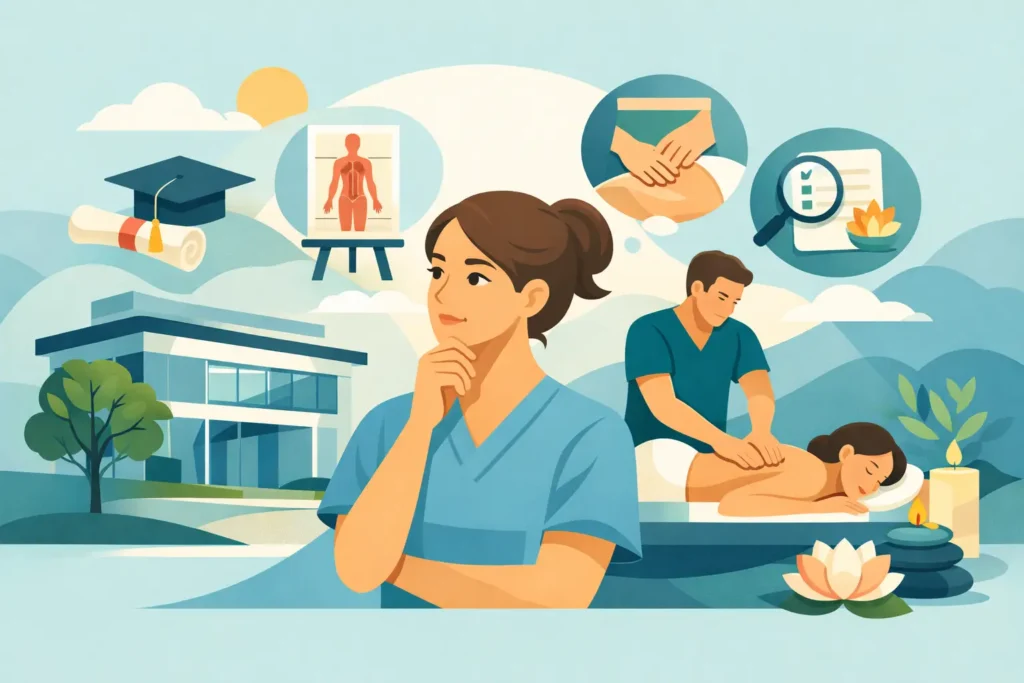
Choosing among massage schools is not just about finding a program that fits your schedule. It is about choosing the environment where you will build the hands, judgment, communication skills, and confidence required to begin a professional path in massage therapy. When clients trust you with their comfort and care, technical knowledge matters – but so does the ability to listen, assess, explain, adapt, and deliver a professional experience.
For future Registered Massage Therapists, the right education should feel connected to the work you want to do after graduation. Look beyond a brochure or a course list. Ask how often you will practice, who will teach you, what kind of feedback you will receive, and whether the curriculum prepares you to work confidently with real people.
What Strong Massage Schools Teach Beyond Technique
Massage therapy education has to cover more than learning a sequence of movements. A career-focused program should help you understand anatomy, physiology, pathology, assessment, treatment planning, and professional standards. These subjects give context to every technique you use. They help you recognize when to modify an approach, when a client may need a referral, and how to make thoughtful decisions within your professional scope.
At the same time, theory only becomes useful when you can apply it. Students need repeated opportunities to practice palpation, positioning, draping, treatment flow, and body mechanics. They also need to learn how to communicate before, during, and after a treatment. A client who feels heard, informed, and comfortable is more likely to trust the process and return.
A program should also address the business side of a wellness career. Client relations, documentation, scheduling, ethics, marketing, and entrepreneurship can make a meaningful difference once you begin working. Some graduates pursue opportunities in clinics, spas, rehabilitation settings, or wellness centers. Others may eventually want to build an independent practice. The training you choose should leave room for both possibilities.
Hands-On Practice Should Be a Core Part of Your Training
One question separates a passive learning experience from career preparation: how much supervised practical training will you receive?
Massage therapy is a hands-on profession. Reading about treatment techniques is necessary, but it cannot replace practicing them. You need time to develop sensitivity in your hands, learn appropriate pressure, improve your posture, and become comfortable adapting to different body types and client needs. Early practice may feel awkward. That is normal. Consistent repetition, guided by constructive feedback, is what turns uncertainty into professional confidence.
Look for a school where practical learning is structured rather than occasional. In-school training should give you opportunities to work through realistic scenarios, complete client consultations, practice treatment planning, and build strong habits around sanitation, draping, privacy, and record keeping.
A practical training environment with real models or clients can be especially valuable when appropriate supervision is in place. It introduces the human side of the profession: greeting a new client, answering questions clearly, managing time, responding to feedback, and maintaining calm professionalism. Those are the moments that help students feel prepared to enter a workplace rather than simply finish a course.
Questions Worth Asking Before You Apply
Before selecting a massage therapy program, ask admissions staff direct questions about the learning experience. You should understand how practical hours are organized, how students are evaluated, and what support is available when a concept or technique feels challenging.
Ask about:
- The balance between classroom instruction, practical training, and clinical experience
- The credentials and current industry experience of instructors
- How students receive feedback on technique, communication, and professionalism
- Whether the curriculum includes business, client-service, and career-readiness skills
The answers can tell you a great deal about what your day-to-day experience will be like. A clear, detailed explanation is more useful than broad promises. Your education is an investment in your next chapter, and you deserve to understand how the program will help you grow.
Learn From Instructors Who Know the Profession
The quality of instruction matters because massage therapy requires both precision and personal judgment. Certified industry professionals can explain the “why” behind a technique, demonstrate proper methods, and help you connect classroom concepts to client care.
Strong instructors do more than correct hand placement. They can help you improve your body mechanics so you work more sustainably, teach you how to conduct yourself in a professional setting, and encourage you when the learning curve feels steep. They understand that students arrive with different levels of experience. Some are beginning a first career; others are returning to school after years in another field.
Supportive instruction does not mean lowering expectations. It means receiving clear standards, honest feedback, and practical guidance that helps you reach those standards. That combination builds resilience as well as skill.
Choose a Program That Prepares You for Professional Requirements
If your goal is to become an RMT in Ontario, you should choose a program that is designed with the province’s professional requirements in mind. Graduation from a massage therapy program is an important milestone, but it is not the same as registration. Applicants must meet the requirements of the relevant regulatory body, including any required examinations and registration steps.
This distinction matters because a serious program should prepare you with a strong foundation for the next stage of the process. Ask how the curriculum addresses professional expectations, ethics, clinical reasoning, documentation, and examination preparation. You want education that respects the responsibility involved in entering a regulated profession.
It also helps to consider your learning style. An accelerated format can be appealing if you are eager to move toward a new career, but it requires focus and reliable time management. A demanding schedule may be worthwhile for a student ready to commit fully. For someone balancing work, family responsibilities, or a major transition, the right fit depends on the support, schedule, and pace that will allow them to succeed.
Build Career Confidence Before Graduation
Employers and clients notice more than credentials. They notice whether you communicate professionally, remain organized, respect boundaries, and deliver a consistent experience. These are skills developed through practice, not memorized the night before an exam.
At Elite College of Business and Healthcare, the Registered Massage Therapy program is designed around practical training, instruction from certified professionals, and career-oriented learning. Students can develop technical ability alongside the client communication, workplace habits, and business awareness that support long-term growth in the field.
For students in Markham, Scarborough, Richmond Hill, and surrounding communities, training close to home can make it easier to take a serious step toward a new professional direction. Admissions guidance can also help you understand program expectations, available financial-aid options where applicable, and the application process before you make your decision.
Your Next Step Starts With a Clear Choice
The right massage therapy program should challenge you, support you, and give you meaningful opportunities to practice before you graduate. Do not settle for a program that treats hands-on learning as an add-on. Seek one that recognizes it as the foundation of your future work.
If you are ready to turn an interest in wellness into a career-focused education, take the next step with purpose. Ask thoughtful questions, visit the learning environment, and choose training that helps you show up prepared for the clients and opportunities ahead. Your career starts with the decision to begin.